
Disclosure: If you click any of our affiliate links and make a purchase, we will earn a commission (at no extra cost to you).

Choosing the right Amazon book categories can help connect a published book with readers who are already shopping for that type of book.
Publishing a book on Amazon involves dozens of decisions, and choosing book categories can feel surprisingly confusing. We may know our book belongs in romance, mystery, self-help, fantasy, or another broad genre, but Amazon gives us a much more detailed set of choices.
- Which categories actually matter?
- Should we choose the most popular category?
- Should we look for categories with fewer competing books?
- Can choosing the wrong category hurt discoverability?
- And how do categories work alongside keywords?
At TrailHawk Publishing, we believe category selection deserves more thought than simply picking the first three options that seem close to our book. Amazon’s categories function like digital shelves, helping readers browse for books that match their interests. KDP currently allows authors to select up to three categories during book setup, and Amazon specifically recommends choosing categories that accurately describe the book.
The good news is that we can approach the process strategically without trying to guess what Amazon’s algorithm wants.
What Are Amazon Book Categories?
Think about walking into a physical bookstore.
You might see shelves labeled Romance, Mystery & Thrillers, Biography, Business, Children’s Books, Science Fiction, or History. Within those broad sections, there may be smaller sections that narrow the subject even further.
Amazon categories work in a similar way. When we publish through Kindle Direct Publishing, or KDP, categories help determine where Amazon places our book within its bookstore. Amazon describes categories as digital shelves that help customers find books that match their interests.
For example, a historical romance might reasonably fit into a historical fiction category and a romance category with a historical-fiction focus.
The important word here is “reasonably.” We should select categories based on what the book actually delivers to the reader. Trying to squeeze a book into an unrelated category simply because it appears easier to rank can create a poor reader experience, and Amazon reserves the right to change inaccurate category placements.

Think of Amazon categories as digital bookshelves where readers browse for their next book.
Categories and Keywords Are Different
One of the most important things we can understand before choosing categories is that categories and keywords serve different purposes.
Categories help Amazon organize our book into browseable sections. Keywords help describe the specific subjects, themes, settings, characters, or concepts readers may search for.
Amazon currently allows up to seven keyword fields for a book. KDP recommends using relevant words or short phrases rather than vague terms.
Imagine we are publishing a historical romance set in Victorian London.
A category might place the book within a historical romance section.
Keywords could be more specific, such as Victorian London, arranged marriage, wealthy heir, forbidden romance, or historical love story, assuming those concepts accurately describe the book.
We should therefore avoid treating our three category selections as three additional keyword fields. They are part of the book’s overall discoverability strategy, but they perform different functions.
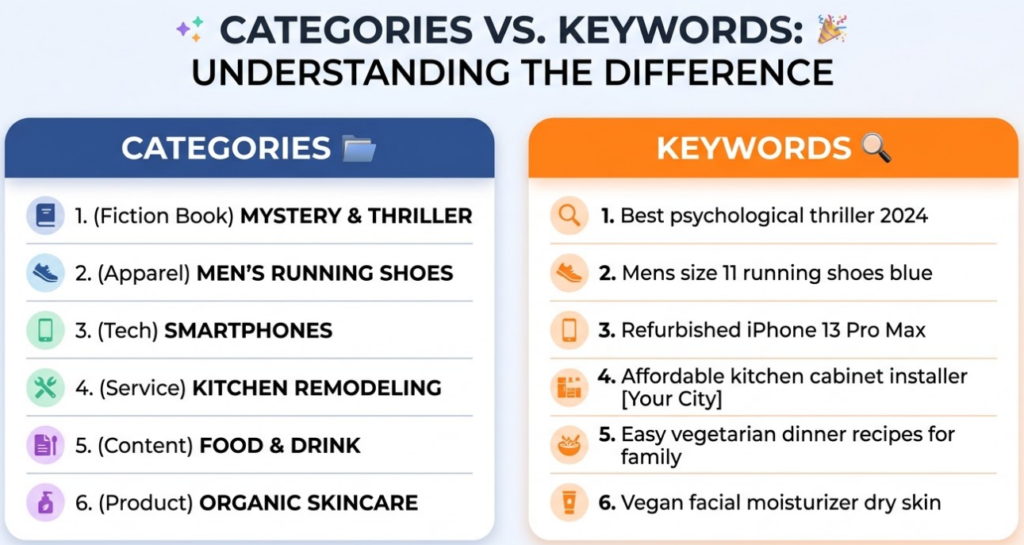
Categories and keywords work together, but they serve different purposes in Amazon book discoverability.
Start With the Book, Not the Category
One of the easiest mistakes we can make is starting with Amazon’s categories before defining what our book actually is.
Instead, we should start by describing the book in plain language.
- What genre is it?
- What subgenre is it?
- Who is the intended reader?
- What kind of experience should the reader expect?
- What themes are central to the book?
- What subjects appear throughout the book?
- What comparable books would our ideal reader already recognize?
This exercise gives us a much clearer starting point. For example, “fiction” is technically accurate for a novel, but it tells us almost nothing about the reader’s expectations.
A psychological thriller, cozy mystery, romantic suspense novel, and literary novel may all be fiction. Their audiences, however, can be dramatically different.
The more accurately we understand our book, the easier it becomes to find the appropriate Amazon shelf.
Research Comparable Books
One of the most useful things we can do before selecting categories is study books that are genuinely comparable to ours. Notice that we said comparable, rather than simply popular.
If we are publishing a cozy mystery, looking at the categories used by a bestselling epic fantasy novel will not tell us much.
We want books that overlap with ours in genre, audience, subject matter, tone, or reading experience.
Look at several successful books rather than relying on one title. Amazon’s categories can change, and category availability can differ by format and marketplace. KDP specifically notes that categories can change over time and that some categories may not be available for every format.
As we research, we can create a simple spreadsheet with columns for:
- Book title
- Genre
- Subgenre
- Format
- Category path
- Comparable audience
- Common keywords
- Notes about positioning
We are looking for patterns. If many comparable books appear in a particular category, that tells us something about where readers shop for that type of book. It does not automatically mean we should choose that category. We still need to determine whether our book genuinely belongs there.

Studying comparable books can reveal useful patterns when we are deciding where our own book belongs.
Do Not Automatically Choose the Biggest Category
It can be tempting to choose the broadest and most popular category available. After all, more shoppers sounds like a good thing.
The problem is competition.
A massive category may contain thousands of books competing for reader attention. A more specific category may have a smaller audience but provide a much clearer match between our book and the readers browsing that section.
Amazon itself recommends balancing popularity and relevance. The goal is to find categories that have reader interest without being so broad or so specific that the book gets lost or fails to fit the audience.
This is one reason category research should involve more than asking, “Which category has the fewest books?”
We should instead ask, “Where are the right readers already looking for a book like ours?”
Those are two very different questions.
Relevance Should Come Before Ranking Strategy
There is a persistent temptation in self-publishing to search for a category that will make it easier to achieve a bestseller badge.
We understand why.
A bestseller label can look impressive, and category rankings can provide authors with a visible measure of performance.
However, Amazon’s bestseller rankings are based on customer activity relative to other books, and Amazon does not guarantee that a book will appear at the top of search results. Search results can change frequently based on factors that include sales history, availability, popularity, and other signals.
That means we should not build our entire publishing strategy around trying to manipulate a category ranking.
A category should first help the right reader discover the right book.
If our book genuinely fits a category and performs well there, excellent.
That is a much healthier strategy than placing a book somewhere misleading simply because we think the competition will be easier.
Think About Reader Expectations
Categories communicate expectations. When readers browse a particular section, they are looking for certain experiences:
- A reader browsing psychological thrillers probably expects suspense, psychological tension, and some form of mystery or danger.
- A reader browsing inspirational Christian nonfiction has different expectations.
- A reader looking for a children’s picture book expects something completely different from someone shopping for an adult literary novel.
This is why accurate categorization matters beyond Amazon’s internal organization. It affects the reader’s decision to click, purchase, read, and ultimately recommend the book.
We explored a related issue in our post “Why Readers Abandon Books So Quickly Now,” where we discussed the importance of matching a book’s presentation and promise to the experience it actually delivers.
Categories are part of that promise.
Your Cover, Description, Keywords, and Categories Should Agree
Think of your book’s metadata as a team:
- Your cover communicates one message.
- Your title and subtitle communicate another layer.
- Your description expands on the promise.
- Your keywords provide additional search language.
- Your categories place the book within particular browsing environments.
All of these elements should point toward the same reader.
If the cover looks like a romantic comedy but the description presents a dark psychological thriller, we have created confusion. If our description says the book is a cozy mystery but we place it in a category associated with hard-boiled crime, the mismatch can create similar problems.
Amazon’s metadata guidelines emphasize accurate and consistent book details, and KDP warns against categories or keywords that do not match the nature of the book.
Consistency is one of the simplest ways we can improve our publishing presentation.
Pay Attention to the Primary Marketplace
Amazon’s category system is not identical across every marketplace.
KDP explains that categories can differ between marketplaces, and authors should focus on their primary marketplace when selecting categories.
For an author primarily selling to readers in the United States, that generally means paying particular attention to the Amazon.com store.
This matters because a category that exists in one Amazon marketplace may not appear in another.
We should therefore avoid assuming that an online tutorial showing a particular category path will look exactly the same in our KDP account.
Amazon changes category structures over time.
The categories we see today may not be identical to categories an author selected several years ago.
What About Low-Content Books?
Low-content books require their own consideration. If we publish journals, planners, notebooks, log books, or similar products, we need to make sure we identify the book appropriately during KDP setup.
Amazon’s current KDP instructions specifically require authors to check the Low-content box for qualifying low-content books. Failing to select it or selecting an incorrect designation can result in rejection.
This is another situation where accuracy matters more than trying to find a clever workaround.
For authors working in the low-content space, tools such as BookBolt can be useful for researching niches and developing products. TrailHawk readers can also use the code TRAILHAWK for 20% off.
The research process should still begin with the actual product we intend to create.
Use Keyword Research Alongside Category Research
Categories are only one part of Amazon discoverability.
Once we understand our category, we can start researching keywords that potential readers might actually use.
Amazon currently allows authors to provide up to seven keywords or short phrases, and KDP recommends choosing terms that accurately relate to the book.
This is where a tool such as Publisher Rocket can become useful for authors who want additional data while researching Amazon keywords, categories, and competitive titles.
We should not blindly copy whatever keyword a tool suggests. Instead, we can use research tools to generate possibilities and then evaluate those possibilities against the actual book.
For example, if our book contains a particular trope, setting, character type, or problem, we can investigate whether readers are searching for that concept.
Then we can determine whether it belongs in our keyword strategy. The tool provides information. We make the publishing decision.

Research tools can help us uncover possibilities, but we still need to evaluate every keyword and category against the actual book.
Avoid Redundant Categories
More categories do not automatically mean better discoverability. Amazon currently allows three category selections, so we want each one to contribute something useful.
KDP also recommends avoiding redundant category choices and emphasizes unique, accurate book details. If two selections essentially communicate the same thing, we may be wasting one of our available opportunities. Instead, we can look for complementary placements.
For example, one category might communicate the broad genre, another could capture the important subgenre, and a third could reflect a particularly relevant subject or audience, assuming those categories are genuinely available and appropriate for the book.
The exact choices will vary by book. There is no universal three-category formula.
Categories Can Be Updated
Choosing categories does not have to be a one-time decision.
If our book is already published, KDP allows us to update its categories through the Bookshelf. Amazon says category updates can take up to 72 hours to appear, and the changes are reviewed to ensure they provide a positive customer experience.
This gives us an opportunity to reassess our positioning later:
- Maybe we misunderstood our genre when we first published.
- Maybe Amazon introduced a more relevant category.
- Maybe our original category disappeared.
- Maybe reader feedback revealed that our book appeals to a somewhat different audience than we initially expected.
Publishing gives us data that we simply cannot have before the book exists.
We can use that information to make smarter decisions.
A Simple Amazon Category Checklist
Before we finalize our categories, we can ask ourselves:
- Does this category accurately describe the book?
- Would the ideal reader reasonably expect to find this book there?
- Does the category match the genre and subgenre?
- Have we researched comparable books?
- Are we choosing relevance over wishful thinking?
- Are the categories available for our specific format and marketplace?
- Are any of our selections redundant?
- Do our categories align with our cover and description?
- Do our keywords complement our categories rather than simply repeating them?
- Would we feel comfortable explaining our category choices to a reader?
If we can answer those questions confidently, we are in a much stronger position.
Category Selection Is Part of the Bigger Publishing Picture
Choosing Amazon book categories may seem like a small technical detail compared with writing a manuscript, designing a cover, or launching a marketing campaign.
It is small, but it matters.
Discoverability is a combination of multiple elements working together.
Amazon itself explains that search results are dynamic and can be influenced by factors such as sales history, availability, and popularity. Categories and keywords can help readers find a book, but they do not guarantee a particular search position.
That distinction is important because we do not want to approach categories as a secret trick that guarantees sales.
We want to approach them as part of our book’s positioning.
Our article “Why Some Self-Published Books Fail Even With Good Writing” explores this broader issue. A well-written manuscript still needs effective packaging, positioning, discoverability, and marketing if we want to give it the best possible chance of finding its audience.
We also explored the importance of understanding readers in “Why Readers Abandon Books So Quickly Now.” Knowing what readers expect from a genre can help us make better decisions about everything from pacing to presentation.
And if we are still wrestling with manuscript structure, “How Long Should a Book Chapter Be?” explores why genre expectations and reader experience matter more than forcing every chapter into an arbitrary word count.
The common thread is reader experience.
Final Thoughts
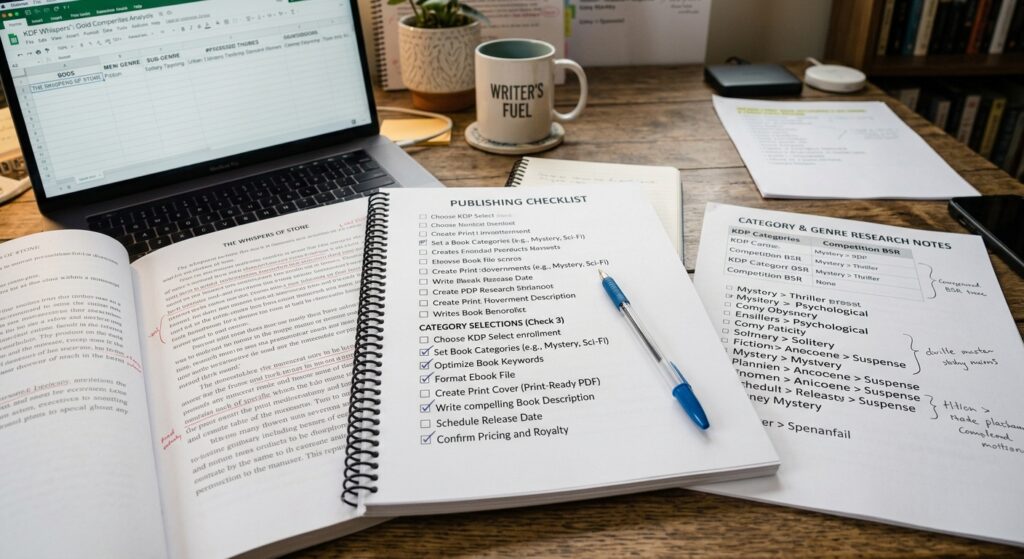
Before publishing, we can use a simple checklist to make sure our categories accurately represent the book.
Choosing Amazon book categories does not need to be a guessing game. We can start with the book itself, identify its genre and audience, research comparable titles, examine relevant category paths, and choose the three options that most accurately position the book for the readers we want to reach.
We should resist the temptation to chase categories simply because they look easy to rank in. We should also avoid assuming that the most popular category is automatically the best one.
The strongest category is usually the one that creates a meaningful connection between the book and the reader browsing that section.
At TrailHawk Publishing, we think of Amazon categories as digital shelves. Our job is to put the book on the shelves where its readers are actually shopping. When the cover, description, keywords, categories, and actual content all tell the same story, we make it easier for readers to understand what we have written and decide whether it belongs on their reading list.
And that is ultimately what good metadata should accomplish.
Have you ever struggled to choose Amazon categories for one of your books? Tell us what kind of book you are publishing in the comments, and let’s see what category research questions come up most often.
Our Affiliate Links:
- Miblart – cover designs and other services
- Bookshop – curated book lists
- Scrivener – writing workflow
- Fiverr – find freelance talent
- Book Bolt – keyword search
- Publisher Rocket – keyword/category search
Our Referral Links:
- Upwork – more freelance talent
- Printful – print-on-demand merch
- Creative Fabrica – fonts and images
Join our community! Follow @TrailHawkPublishing for publishing tips and behind-the-scenes updates: